If Someone Claiming to Be Police Demands Payment, It's a Scam
The FBI has renewed its warning about scammers posing as police and government officials. Here's how the script works, and what to do if you already paid.
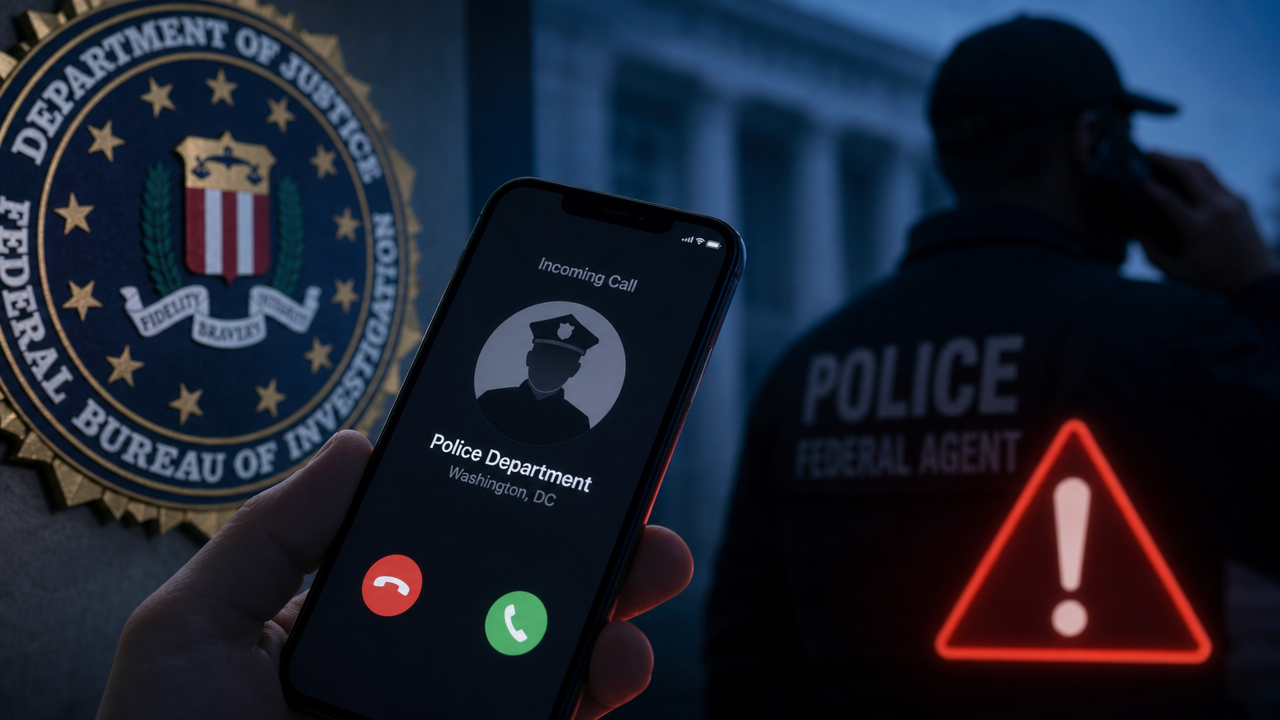
The FBI has renewed a warning that scammers around the world are posing as police officers and government officials to pressure people into handing over money or personal information.
If you have already been caught by one of these calls, please know that nothing about that makes you careless or foolish. These calls are built by people who do this every day, and they are designed to work on calm, careful adults. You are not the first person this happened to, and you will not be the last.
ShieldMate is not an emergency service. If you are in immediate danger, call your local emergency number. If you need support or you are not sure what to do next, our Get help page will point you to the right place for your country.
What the FBI said
The alert, published on 17 September 2026, updates a warning the FBI first issued in March 2022. It covers scams in which criminals impersonate law enforcement and government officials, both American and foreign, to extort money or personal information.
The numbers come from complaints filed in the United States, so they are not a worldwide total. They are still worth looking at, because they show the scale of just one country's reported cases. Between January 2025 and July 2026, the FBI's Internet Crime Complaint Center received almost 61,000 complaints about law enforcement and government impersonation, with reported losses of more than 1.6 billion US dollars. Most people who are targeted never report it at all, so the real figure in any country is higher than the one on the record.
How the script works
Contact usually starts with a phone call you were not expecting, although text messages and emails are used too. The caller's number often looks real, because scammers can spoof genuine agency phone numbers, email addresses, staff names, and credentials. The FBI notes that scammers have even spoofed IC3 itself.
From there, the pattern is consistent:
- The caller is urgent and aggressive, and accuses you of something serious.
- They refuse to speak to anyone but you, and will not leave a message.
- They try to keep you on the phone for the entire call, so you have no quiet moment to check anything.
- They tell you not to talk to family, friends, your bank, or the police about it.
That last one is the tell. A real investigator has no reason to stop you from calling your own bank or walking into a police station. Isolation is not a side effect of these calls. It is the whole method.
Payment is demanded in forms that are hard to reverse: prepaid cards, couriers collecting cash in person, bank wires, cryptocurrency, or cash fed into cryptocurrency kiosks.
The stories they use
The FBI describes several recurring pretexts, each with its own US complaint figures for January 2025 to July 2026:
- You are connected to a crime. The caller threatens arrest, prosecution, or prison unless you pay to have charges dropped or to help catch the "real" criminals. This accounts for the majority of government impersonation complaints.
- You missed jury duty or a court date. The caller says a fine is owed or a warrant is out for your arrest. 6,833 complaints, with losses of nearly 36 million US dollars.
- Your passport, driver's license, or professional license is expiring. The caller demands a renewal payment. 496 complaints, with losses of more than 348,000 US dollars.
- Your professional license has been misused. Medical practitioners in particular are told their license was used in a crime or is about to be revoked, and that paying will protect it. 3,322 complaints, with losses of more than 37 million US dollars.
- Foreign officials are coming for you. Scammers posing as overseas law enforcement or foreign diplomatic staff threaten victims with extradition or the cancellation of their home country passport. 1,809 complaints, with losses of more than 140 million US dollars.
That last category is the one that reaches furthest beyond any single country's borders. It targets people living away from home, including foreign nationals and international students, and it is deliberately difficult to check, because the officials being named are in another country. In some cases the FBI says scammers have gone as far as wearing fake police uniforms and building mock government offices as backdrops.
Which brings up the newest part of the warning. Scammers are now using artificial intelligence to appear as officials on video calls. Seeing a face in a uniform is no longer proof that anyone on the call is real.
What stays true anywhere in the world
Laws and agency names differ from country to country, but a few things hold up almost everywhere, and the FBI states them plainly:
- Police and government agencies do not call or text members of the public to demand payment.
- They do not ask for payment in prepaid cards, cryptocurrency, or cash handed to a courier.
- You are always allowed to hang up and call the agency back yourself. Find the number through the agency's official website or a public directory. Never use a number, link, or callback detail given to you by the person who contacted you.
- If you are sent a web address, look at the domain carefully before clicking. Scammers register addresses that look almost identical to official ones, with a small spelling change or a different ending.
There is no such thing as being rude to a real investigator by asking to verify them. If someone objects to being checked, that is your answer.
If this already happened to you
Take these in order, and do not worry about doing them perfectly.
- Stop all contact. Do not answer again, do not explain, and do not try to get your money back through them. Any follow-up contact offering to recover your funds should be treated as part of the same scam.
- Call your bank or payment provider now. Speed matters more than anything else here. Tell them the payment was fraudulent and ask what can be stopped or recalled. Do the same with any cryptocurrency exchange you used.
- Save everything. Phone numbers, email addresses, messages, screenshots, payment receipts, and any cryptocurrency wallet addresses. Keep the originals rather than retyping them.
- Report it where you live. Contact your local police and your country's national cyber crime or fraud reporting body. Reporting rarely feels satisfying in the moment, but these cases are usually connected to many others, and your details can matter to an investigation you never hear about.
- Tell one person you trust. The call worked partly by keeping you alone with it. Saying it out loud to someone is one of the fastest ways to take that power back.
Not sure who to report to in your country? Our Get help page has the details.
One more thing
If someone you know has been through this, the most useful thing you can say is some version of "that call was designed to do exactly this." Shame keeps people quiet, quiet keeps them paying, and the people running these scams rely on both.
It happened to them too
First-hand accounts of this exact scam.
A fake alert inside my crypto app cost me $28,000
“I'm still reeling from this, but I need to get the story out there because it’s honestly terrifying how easily it…”
My friend found a Facebook page full of AI deepfakes of her
“last night, i woke up to my friend spam calling me, and when i answered, i immediately heard sobs from the other side.…”